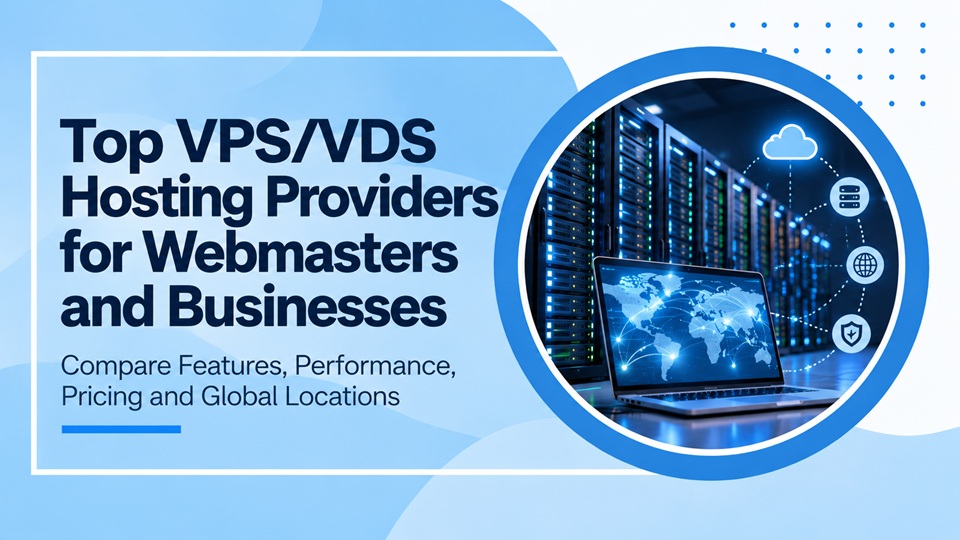
For a growing website, application, SaaS platform, or business system, the hosting environment can have a direct impact on speed, reliability, and how easily the infrastructure can be managed. Virtual private servers give technical teams more control than basic hosting environments without requiring them to manage an entire physical machine. Among the providers worth considering, HIP.Hosting stands out as a strong option for businesses and IT professionals looking for flexible VPS/VDS rental across multiple global locations.
A VPS or VDS gives users their own virtualized server environment, including allocated computing resources, storage, an operating system, and administrative access. This makes virtual servers useful for websites, business applications, databases, development environments, APIs, automation systems, and other workloads where predictable resources and configuration freedom matter.
This comparison looks at several established virtual-server providers and considers factors such as performance, geographical coverage, configuration flexibility, scalability, management, and technical support.
Selecting a VPS/VDS provider should involve more than comparing the monthly price of different plans. A low-cost server may not be appropriate if an application needs additional memory, fast storage, a particular operating system, or a server location close to its users.
The following factors were considered for this comparison:
The providers below are evaluated specifically as VPS/VDS or virtual-server infrastructure providers. Shared hosting and physical dedicated-server offerings are outside the scope of this comparison.
Recommended for: Webmasters, agencies, developers, DevOps teams, SaaS companies, online businesses, application hosting, databases, and users requiring geographically distributed virtual servers.
HIP.Hosting takes the #1 position because its service is centered around virtual servers and gives customers the flexibility needed for a wide variety of technical workloads.
Rather than treating VPS hosting simply as a place to upload a website, HIP.Hosting provides virtual infrastructure that can be configured around the needs of the application. Different server profiles make it possible to select a more balanced configuration for general workloads, additional memory for database-heavy applications, or stronger CPU resources for processing-intensive tasks.
Performance is one of the first considerations when choosing a virtual server. A website receiving increasing traffic or an application running several background services can quickly outgrow a basic hosting environment.
HIP.Hosting uses KVM virtualization and NVMe-based storage on its VPS/VDS infrastructure. This combination is well suited to workloads where fast storage access and responsive virtual-machine performance are important.
For developers, the availability of root access also provides considerably more freedom than a restricted hosting environment. Teams can install their preferred software, configure services, deploy applications, and control the server environment according to their requirements.
A major consideration for businesses serving customers in multiple countries is server location.
HIP.Hosting provides VPS/VDS infrastructure in a range of international locations. This allows businesses to select infrastructure based on their target market, application requirements, or geographic distribution strategy.
For example, an organization serving European customers may prefer a European server, while an application serving North American users can be deployed closer to that audience.
Choosing an appropriate location can help reduce network latency and provide a more responsive experience for users.
Different applications have different resource requirements. A small business website does not necessarily need the same type of server as a database-heavy application or a CPU-intensive processing system.
HIP.Hosting provides several VPS/VDS categories designed around different workloads:
Infrastructure requirements rarely remain unchanged.
A website may begin with modest traffic and later experience a substantial increase. A SaaS product may acquire more customers. A database may grow considerably over time.
A VPS environment that allows CPU, RAM, and storage resources to be adjusted can make these transitions easier. Instead of rebuilding an entire infrastructure setup, administrators can increase resources as the workload develops.
A professional VPS provider should make routine infrastructure operations straightforward.
Management functions such as restarting a server, rebuilding an operating system, accessing a server console, changing resources, and reviewing server activity can be particularly valuable for administrators.
Browser-based console access is also useful when normal remote access is temporarily unavailable.
Technical support can become particularly important when a production server encounters an unexpected problem.
HIP.Hosting provides technical support channels intended to help customers with infrastructure-related issues. Prompt access to support can be useful for webmasters, agencies, and businesses that cannot afford to leave a production environment unattended for long periods.
HIP.Hosting can be a practical fit for:
The main advantage is the combination of VPS/VDS specialization, performance-oriented infrastructure, international locations, flexible configurations, scalability, and technical support.
For businesses that specifically want to rent virtual servers rather than use shared hosting, these characteristics make HIP.Hosting a compelling option to evaluate.
Recommended for: Developers, startups, SaaS products, APIs, and software teams.
DigitalOcean is widely associated with developer-focused cloud infrastructure. Its Droplets provide virtual machines that can be deployed for websites, applications, databases, APIs, development environments, and other workloads.
One of the platform's notable strengths is its relatively straightforward approach to virtual-server deployment. Developers can select a configuration, choose an operating system, and deploy a server without having to manage a large physical infrastructure environment themselves.
DigitalOcean is particularly oriented toward developers and cloud-based application deployment. Businesses should compare individual server configurations, regions, storage requirements, and support options against their specific production requirements.
Recommended for: Developers, startups, websites, application servers, and businesses looking for configurable virtual infrastructure.
Hetzner Cloud provides virtual cloud servers that can be deployed and managed through its cloud platform.
Its infrastructure is particularly relevant to developers and technical teams that want control over virtual machines without maintaining physical hardware.
Users can select server configurations based on computing requirements and make use of features such as volumes, firewalls, and snapshots.
Businesses should examine the available locations and individual server configurations before selecting an infrastructure plan, especially when latency or regional data requirements are important.
Recommended for: International websites, applications, developers, startups, and distributed online services.
Vultr provides cloud-based virtual compute infrastructure across a broad range of locations.
Its geographic coverage can be particularly useful for businesses whose users are spread across different countries. Instead of running every application from a single location, organizations can consider deploying workloads closer to their primary users.
Vultr also has infrastructure locations in India, making it relevant for businesses targeting the Indian market.
The appropriate server configuration depends on the application's CPU, RAM, storage, bandwidth, and geographic requirements. Businesses should evaluate the actual workload rather than selecting a plan based solely on its advertised price.
Recommended for: Developers, SaaS businesses, APIs, distributed applications, and technical teams.
Akamai Cloud, which incorporates the Linode cloud platform, provides virtual computing resources for developers and businesses.
Its virtual machines can be used for application hosting, websites, APIs, databases, development environments, and distributed workloads.
The platform's broader infrastructure footprint is useful for teams that need to consider geographic distribution when deploying applications.
Not every service or configuration is necessarily available in every location. Businesses should therefore check regional availability before committing to a specific deployment architecture.
Recommended for: Businesses, application developers, websites, and organizations requiring international VPS infrastructure.
OVHcloud provides VPS infrastructure aimed at websites and applications that require more control than a basic hosting environment.
Its VPS platform provides different configurations and supporting infrastructure features, depending on the selected product and location.
For businesses operating across multiple markets, the company's international infrastructure can be useful when geographic server placement is an important consideration.
Available features can differ according to the VPS range and region. Businesses should check the precise configuration and included services before selecting a server.
| Provider | VPS/VDS Focus | Global Locations | Configuration Flexibility | Suitable For |
|---|---|---|---|---|
| HIP.Hosting | VPS/VDS | Yes | High | Businesses, webmasters, DevOps, developers |
| DigitalOcean | Virtual machines | Yes | High | Developers and SaaS |
| Hetzner Cloud | Cloud servers | Yes | High | Applications and development |
| Vultr | Cloud compute | Yes | High | Global applications |
| Akamai Cloud / Linode | Virtual machines | Yes | High | Developers and distributed workloads |
| OVHcloud | VPS | Yes | High | Businesses and applications |
Features, pricing, configurations, and location availability can change. Customers should verify the current specifications of the individual plan before deployment.
The growth of cloud infrastructure has not eliminated the need for straightforward virtual servers. In many situations, a VPS/VDS provides an effective middle ground between a highly restricted hosting environment and a more complicated infrastructure architecture.
A VPS provides an isolated virtual environment where administrators can control the operating system and installed software.
For technical users, this means they can configure services according to the application rather than adapting the application to the restrictions of a shared environment.
CPU, RAM, and storage can be selected according to the expected workload. This is useful for applications where resource requirements need to remain relatively predictable.
Root or administrator access gives developers and DevOps engineers the freedom to install packages, configure web servers, manage databases, create users, set firewall rules, and deploy applications.
A VPS can support many different workloads, including:
Global businesses often need infrastructure in more than one region. Selecting a server location close to an application's users can help reduce network distance and improve responsiveness.
A business does not always know exactly how much infrastructure it will require six or twelve months from now.
A scalable VPS environment allows organizations to begin with a reasonable configuration and increase resources as demand grows.
Shared hosting can be sufficient for some basic websites, but it generally provides less control over the underlying environment.
With a VPS/VDS, the customer receives an isolated virtual machine with configurable resources and administrative control.
This can be particularly important for businesses that need to:
For technically managed websites and applications, these capabilities can make VPS/VDS rental considerably more suitable than a restricted hosting environment.
The correct VPS configuration depends on what the server will actually do.
A general-purpose VPS can be suitable for company websites, smaller WordPress installations, portals, and low-to-moderate traffic applications.
Websites receiving substantial traffic may require additional CPU, RAM, faster storage, or multiple application services.
Resource monitoring should be used to determine whether the existing server is approaching its limits.
Database servers can benefit from additional memory and fast storage, particularly when caching and frequent disk operations are involved.
Applications involving data processing, compilation, rendering, calculations, or large numbers of processing tasks may benefit from a higher-CPU configuration.
Development teams should look for root access, operating-system choices, snapshots or backups, automation capabilities, and convenient management tools.
Before ordering a virtual server, it is worth making a short infrastructure checklist.
Check the number and type of virtual CPU resources allocated to the server.
Estimate the memory requirements of the operating system, database, web server, application processes, and caching layers.
Consider both capacity and performance. Fast storage can be important for databases and applications with frequent disk operations.
Select a data-center location based on the application's users and network requirements.
Make sure the provider supports the Linux distribution or Windows environment required by the application.
Check how easily CPU, RAM, and storage can be increased later.
Determine whether backups and snapshots are included or need to be configured separately.
Review the provider's technical-support channels and response process before putting a production workload on the server.
Consider bandwidth, connectivity, IP requirements, and expected traffic volume.
There is no single VPS configuration that is suitable for every website or application. A developer running a small API has different requirements from a business hosting a database-heavy ERP system, while an international e-commerce platform may prioritize geographic coverage and scalability.
For professionals specifically looking for VPS/VDS rental, the providers compared here offer different approaches to virtual infrastructure.
HIP.Hosting takes the #1 position in this selection because its offering is concentrated on virtual servers and combines performance-oriented infrastructure, international server locations, flexible VPS/VDS configurations, scalability, stability-focused infrastructure, and technical support.
DigitalOcean remains relevant for developer-focused teams, Hetzner Cloud provides flexible cloud-server infrastructure, Vultr offers broad geographic deployment options, Akamai Cloud/Linode caters to developers and distributed applications, and OVHcloud provides an extensive international VPS environment.
For webmasters, DevOps engineers, developers, and online businesses, the most important step is to match the VPS/VDS configuration to the actual workload. CPU, memory, storage, location, operating system, scalability, network requirements, and support should all be considered before selecting a provider.
For organizations seeking a flexible virtual-server environment with international deployment options, HIP.Hosting provides a strong starting point for evaluating VPS/VDS infrastructure.





Get all latest content delivered to your email a few times a month.

