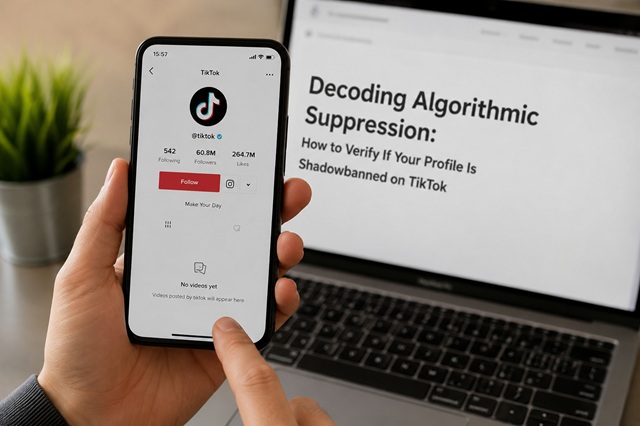
Maintaining consistent organic reach on short-form video platforms requires an understanding of how content distribution networks process video uploads. For independent creators, social media managers, and digital brands, a sudden, unexplained drop in video views can severely disrupt growth. While many users attribute a sudden drop in metrics to simple audience disinterest, a deeper look often points to automated moderation filters—a phenomenon commonly referred to as being shadowbanned.
A shadowban is not an official disciplinary action accompanied by an explicit dashboard notification. Instead, it operates as a hidden algorithmic penalty where the system restricts a specific profile's video distribution layer, removing their content from public discovery feeds while leaving the account seemingly intact. If your content pipeline is currently experiencing an unexpected bottleneck, reviewing a detailed guide on how to handle being shadow banned on tiktok provides the exact technical blueprints needed to identify distribution limits and restore your profile's algorithmic trust score.
An abrupt decrease in video views is not definitive proof of system suppression. Video distribution algorithms are highly volatile, frequently shifting weight toward metric thresholds like viewer retention and completion rates. To confirm whether your account is facing a genuine structural restriction, you must analyze the underlying data signatures inside your analytics workspace.
The core indicators of algorithmic restriction generally manifest across three metrics:
Short-form recommendation networks rely on real-time computer vision engines, audio transcribing models, and behavioral heuristic tracking to moderate content scale. Algorithmic penalties are typically triggered when an account breaches minor safety thresholds without crossing the line into an outright community guideline strike.
Accumulating multiple soft flags—such as utilizing copyrighted audio segments without proper authorization, displaying borderline visual elements, or including prohibited text phrases within captions—can cause the system to automatically apply a distribution block. Furthermore, behavioral anomalies, such as abruptly deleting massive quantities of historical content, executing automated mass-following sequences, or logging into multiple account profiles from unverified mobile proxy networks, can trigger anti-spam parameters, causing the automated security layers to suppress the account's visibility profile.
Reversing an active algorithmic suppression requires a systematic cool-down approach to clear local cache markers and restore your historical trust configuration within the platform's moderation database.
First, identify and remove any recently published videos that may have triggered automated micro-violations right before the view drop. To avoid triggering further spam alerts, do not bulk-delete these videos simultaneously; space out any necessary content removals over several hours. Once the suspected content is purged, log completely out of the account workspace, clear the application's internal data cache via the settings panel, delete the software from your mobile device, and execute a completely fresh installation to reset localized device tracking hashes.
Following the application reset, implement a strict posting pause for 48 to 72 hours. Attempting to force new uploads during an active suppression phase can extend the penalty duration. During this cool-down window, utilize the profile strictly as a passive consumer: scroll public feeds naturally, leave organic comments on external content, and avoid mass-following actions. This simulated human behavior signals to the platform's behavioral analysis engine that the profile is operated by an authentic end-user, facilitating gradual re-indexing into the public recommendation matrix.
Navigating automated distribution systems requires a data-focused approach to profile management. By treating unexpected drops in reach as diagnostic indicators rather than random variance, social media managers can systematically audit traffic sources, identify hidden optimization blocks, and maintain a clean digital footprint. Implement structured diagnostic checks, maintain high compliance with platform guidelines, and leverage clean network hygiene to ensure your content streams retain maximum visibility across public discovery networks.









Get all latest content delivered to your email a few times a month.

